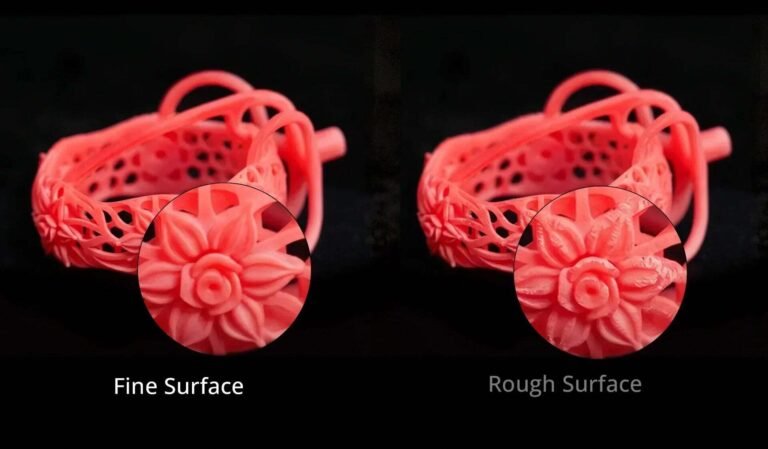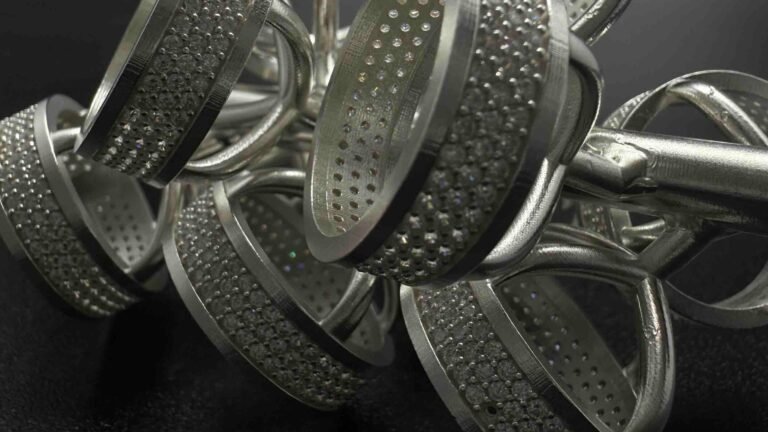
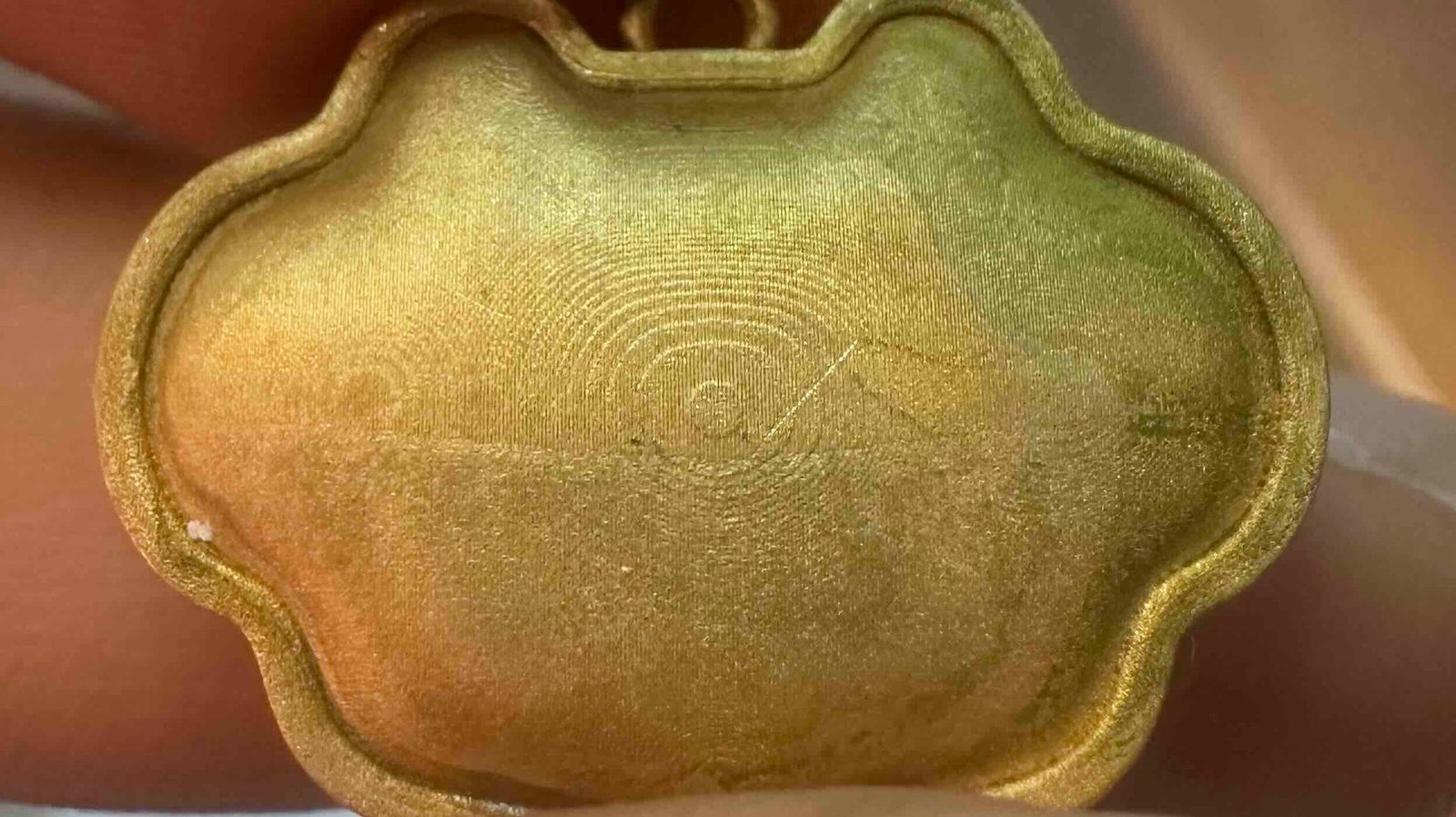
In jewelry wax 3D printing, one of the first things manufacturers notice under direct lighting is a clear difference in surface quality. Some wax patterns appear exceptionally smooth, while others show subtle wave-like textures that resemble water ripples.
While such surface artifacts may be acceptable in general industrial parts, they are a serious concern in jewelry manufacturing. Even minor surface irregularities in wax patterns can impact the final metal casting—affecting polish quality, detail sharpness, and overall premium appearance.
This is why reducing “water ripple” textures is considered one of the most important challenges in jewelry wax 3D printing.
What Are Water Ripple Textures?
Water ripple textures refer to repetitive surface patterns that appear due to accumulated microscopic deviations during the printing process.
Unlike traditional molding, wax 3D printing builds models layer by layer through:
- Continuous printhead movement
- Layer-by-layer deposition
- Repeated platform lifting
- Complex toolpath execution
Even small instabilities during these steps—such as vibration, motion deviation, inconsistent droplet placement, or path errors—gradually accumulate on the surface.
Over time, these tiny variations form visible patterns such as:
- Wave-like textures
- Layer lines
- Circular banding
- Surface striping
- Ripple marks on curved areas
These effects are especially noticeable on jewelry models because of their small size and highly detailed curved geometry.
Stair-Stepping Effect and Curved Surfaces
Curved geometries such as rings, pendants, and spherical designs are particularly sensitive to ripple formation.
This is due to the stair-stepping effect, where curved surfaces are approximated using stacked layers.
The larger the layer thickness, the more visible the stepping becomes. Even in fine-resolution printing, minor inconsistencies can affect how light reflects off the final metal surface after casting.
As a result, jewelry wax printing heavily depends on:
- Z-axis precision
- Minimal layer thickness
- Advanced path optimization
For example, a 15 μm layer thickness can significantly improve surface smoothness and reduce visible transitions on curved jewelry models.
Key Causes of Water Ripple Textures
1. Mechanical Vibration
Mechanical vibration is one of the most common sources of surface ripple patterns.
During high-speed printing, even small structural instabilities can lead to:
- Micro-shaking of the printhead
- Resonance during motion
- Positional inaccuracies
- Repeated trajectory deviations
These variations accumulate over time and become visible as periodic surface waves.
Machines with lower rigidity or unstable motion systems tend to show more pronounced ripple effects, especially during fast or large-area printing.
This is why modern WaxJet systems focus heavily on:
- Structural rigidity
- Stable guide rails
- Balanced motion systems
- Vibration damping mechanisms
2. Printhead and Platform Motion Accuracy
Surface quality also depends heavily on synchronization between:
- Printhead movement
- Wax droplet jetting timing
- Platform elevation
- Path transitions
Even slight inconsistencies in speed, timing, or positioning can result in uneven droplet placement.
These errors appear as:
- Circular wave patterns
- Uneven gloss reflections
- Layer-based striping
- Surface distortion on curves
Curved surfaces amplify these issues because they continuously reflect light, making even small deviations more visible.
3. Sensitivity of Curved Geometry
Curved jewelry surfaces are the most challenging to print smoothly.
Common high-risk areas include:
- Ring exteriors
- Pendants
- Sculpted surfaces
- Spherical designs
- Fine curved engravings
These shapes are built using continuous approximations of discrete layers. Any instability in motion, path planning, or layer deposition becomes highly visible.
This is why surface quality evaluation in jewelry printing often focuses on ring outer surfaces—they reveal even the smallest printing imperfections.
Why Polishing Cannot Fully Fix Ripple Textures
A common misconception is that surface ripple textures can be corrected through polishing.
However, in jewelry manufacturing, excessive post-processing creates new problems:
- Loss of fine details
- Softening of sharp edges
- Reduced engraving clarity
- Dimensional inaccuracies
- Damage to micro pavé structures
Jewelry models often contain extremely delicate features that cannot withstand aggressive polishing.
Because of this, modern manufacturing emphasizes achieving smooth surfaces directly during the printing stage rather than relying on corrective finishing.
The Industry Shift: Quality at the Source
High-end jewelry production now prioritizes:
- Smooth wax surfaces immediately after printing
- Minimal post-processing
- Stable and repeatable printing conditions
- Precision-controlled motion systems
The goal is simple: eliminate ripple formation at the source instead of correcting it later.
When wax patterns are produced with high stability, accurate calibration, and optimized motion control, manufacturers achieve:
- Cleaner metal casting results
- Higher surface polish quality
- Better detail preservation
- Reduced production time
Conclusion
Water ripple textures are not just a surface defect—they are a reflection of the entire printing system’s stability.
They originate from a combination of:
- Mechanical vibration
- Motion inaccuracies
- Layer-based construction limits
- Curved surface sensitivity
- Process instability
In jewelry wax 3D printing, true quality is defined not only by resolution, but by the ability to maintain smooth, consistent surfaces across complex geometries.
Ultimately, the smoother the wax pattern, the more refined and premium the final jewelry piece becomes.